01 · Occupied
Players are detected
The camera feed shows human presence on the court and lighting remains active.

Korv Glanz analyzed court occupancy using existing video infrastructure and Edge AI, identifying 36.3 aggregate court-hours of unnecessary lighting during a 24-hour audit.
24-Hour Audit
A 6-Court Commercial Sports Facility
Commercial sports arenas pay to power high-wattage floodlights over empty courts during booking gaps, late arrivals and overnight closures.
Korv Glanz uses the facility's existing cameras and an on-site edge AI unit to see when a court is actually in use, and to switch its lights off when it isn't.
A 24-hour audit of a 6-court facility measured how much of that lighting was avoidable. The results below are what the audit observed; annual figures are projections from that day.
Once it is set up, nobody has to remember to check the courts or walk to the switchboard.
The operational issue was not simply switching lights. It was knowing when a court was actually being used.
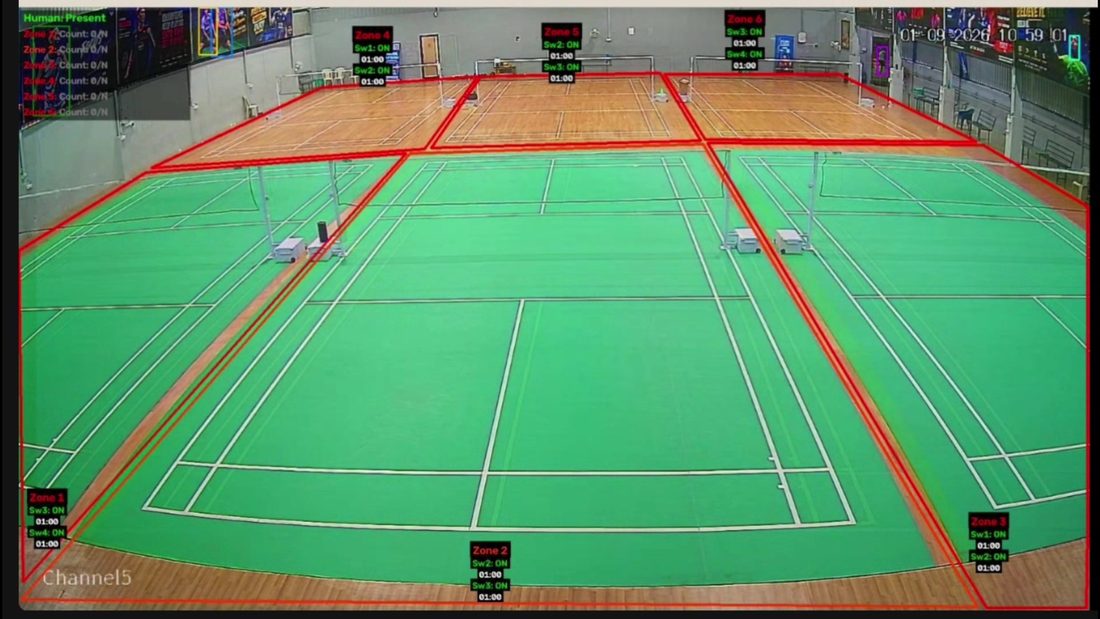
Staff relied on phone alarms and memory to manage lighting schedules.
Employees sometimes had to physically access switches or switchboards to manage lighting circuits.
Lighting could remain active during booking gaps, unused court periods, closing, or overnight periods.
Management had limited court-level visibility into unnecessary lighting hours and energy consumption.
Energy was consumed when courts were not actively occupied.
Employees spent time checking courts and managing lighting rather than relying on an occupancy-based process.
There was no centralized telemetry view of idle runtime and estimated savings.
Korv Glanz observed a 6-court facility over a 24-hour period to identify lighting that remained active while courts were unoccupied.
The audit observed one 24-hour operating day. The savings apply the facility's own EB bill to the idle lighting it identified, and the annual figures assume the same pattern every day.
Korv Glanz uses existing camera feeds as an operational input, applying local Edge AI to detect occupancy and trigger the lighting-control layer when a court remains empty.
Camera → Edge AI → Occupancy Detection → 90-Second Verification → Lighting Automation → Energy Telemetry
Compatible camera feeds provide the visual input for occupancy analysis.
On-site processing enables local, real-time occupancy decisions without dependence on cloud processing for inference.
A YOLO-based computer vision model detects human presence and helps determine whether individual courts are occupied.
The system applies an approximately 90-second safety buffer before triggering a lighting-control action.
A Wi-Fi-enabled smart switching layer connects the AI decision to the physical lighting circuits.
Cloud telemetry records operating events and provides visibility into estimated energy and financial savings.
Lighting decisions are driven by observed occupancy rather than relying only on booking schedules or staff memory.
The camera feed shows human presence on the court and lighting remains active.
When players leave, the occupancy state changes and the safety period begins.
The system waits approximately 90 seconds before taking action, helping avoid unnecessary switching.
If the court remains empty, the lighting-control interface receives the command to turn the lights off.
When players return, the system detects occupancy and the appropriate lighting action occurs based on the configuration.
Operating events are captured for visibility into runtime, estimated energy reduction, and financial value.
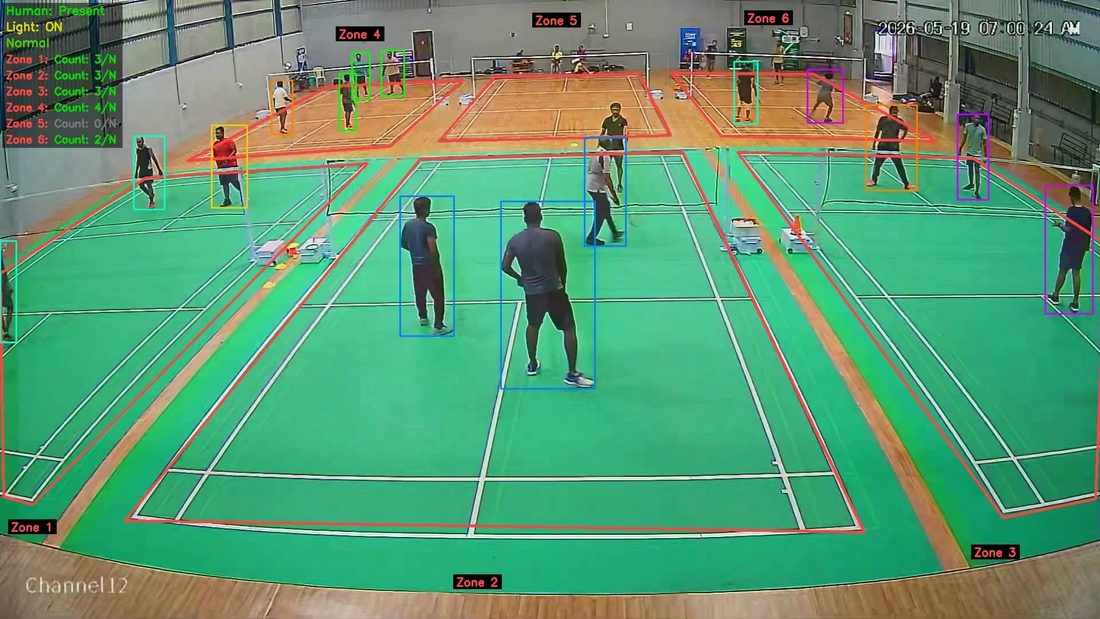
Recorded during testing at the facility. Players are boxed and counted per zone while the courts are in use; once a court empties, its lights are switched off.
Every player is detected and counted by zone, so the lights stay on wherever people are playing.
When no one is left on the courts, the switches turn off. When someone walks back in, the lights come back on.
For a multi-court arena, electricity is one of the largest fixed costs. Switching lights off as soon as a court is empty, instead of relying on staff and reminders, is where the savings come from.
Estimate your potential energy savings based on your number of courts, operating hours, electricity tariff and lighting wattage.
Calculator estimates are based on the reference energy-saving results from the Korv Glanz 6-court audit and are intended as an estimation model. Actual savings vary by facility, lighting load, operating hours and electricity tariff.
₹0
Estimated energy cost reduction₹0
Estimated yearly energy savingsEstimated reduction in unused lighting energy
Per Month
0 hrs
0%
See how Korv Glanz AI can automate court lighting, reduce manual intervention, and help you understand the savings potential for your locations.
Tell us a little about your facility and our team will get in touch.